


Email remains a cornerstone of business communication and marketing. With billions of emails sent daily, it’s crucial to ensure that messages reach their intended recipients. This is where email verification steps in, a vital process for anyone leveraging email for professional or marketing purposes.
The Basics of Email Verification
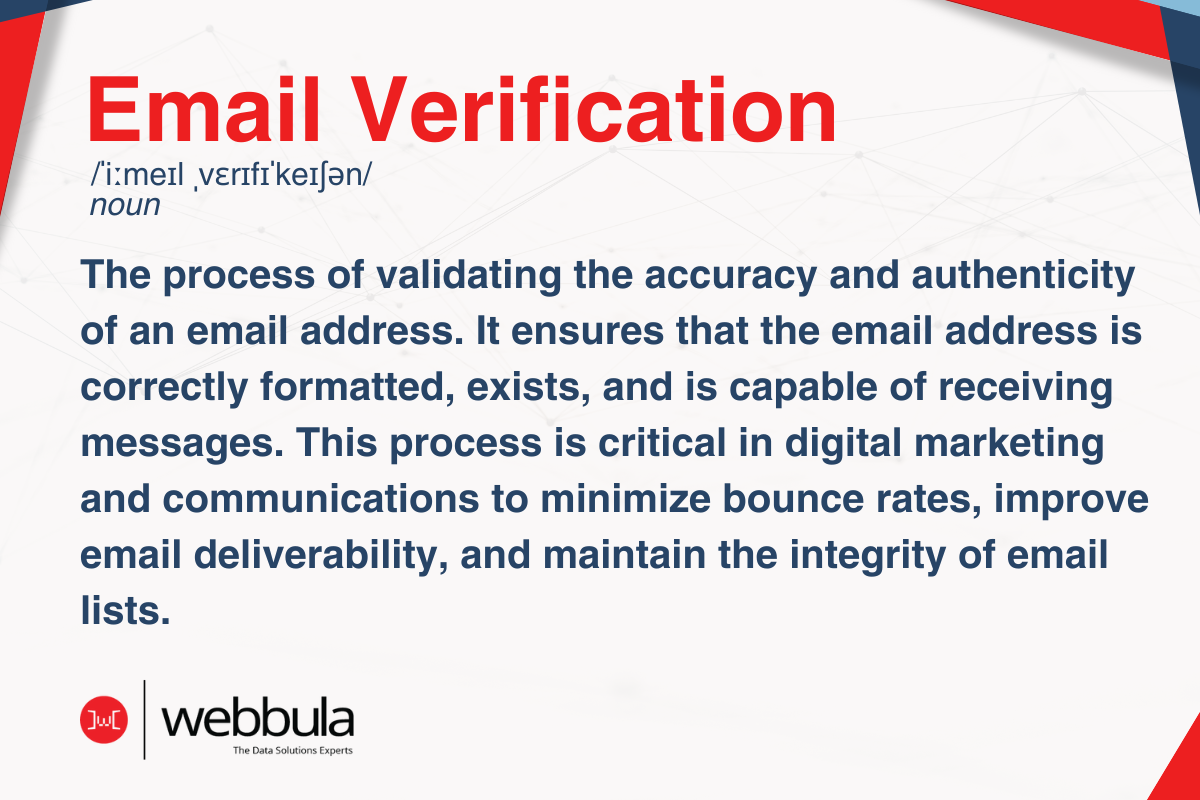
What is email verification? It’s a process that checks the validity of an email address to confirm that an email address exists, is active, and is owned by the user it represents. This ensures that email data contributes positively to the health of your email list and the effectiveness of your email marketing efforts.
Why is Email Verification Important?
Verifying email addresses helps in:
- Reducing bounce rates by eliminating invalid addresses.
- Protecting your domain from being associated with spam and fraud.
- Improving the overall deliverability of your emails by ensuring you’re sending to valid email addresses.
- Keeping your email list updated, which is particularly important to comply with strict data protection laws.
How Email Verification Works
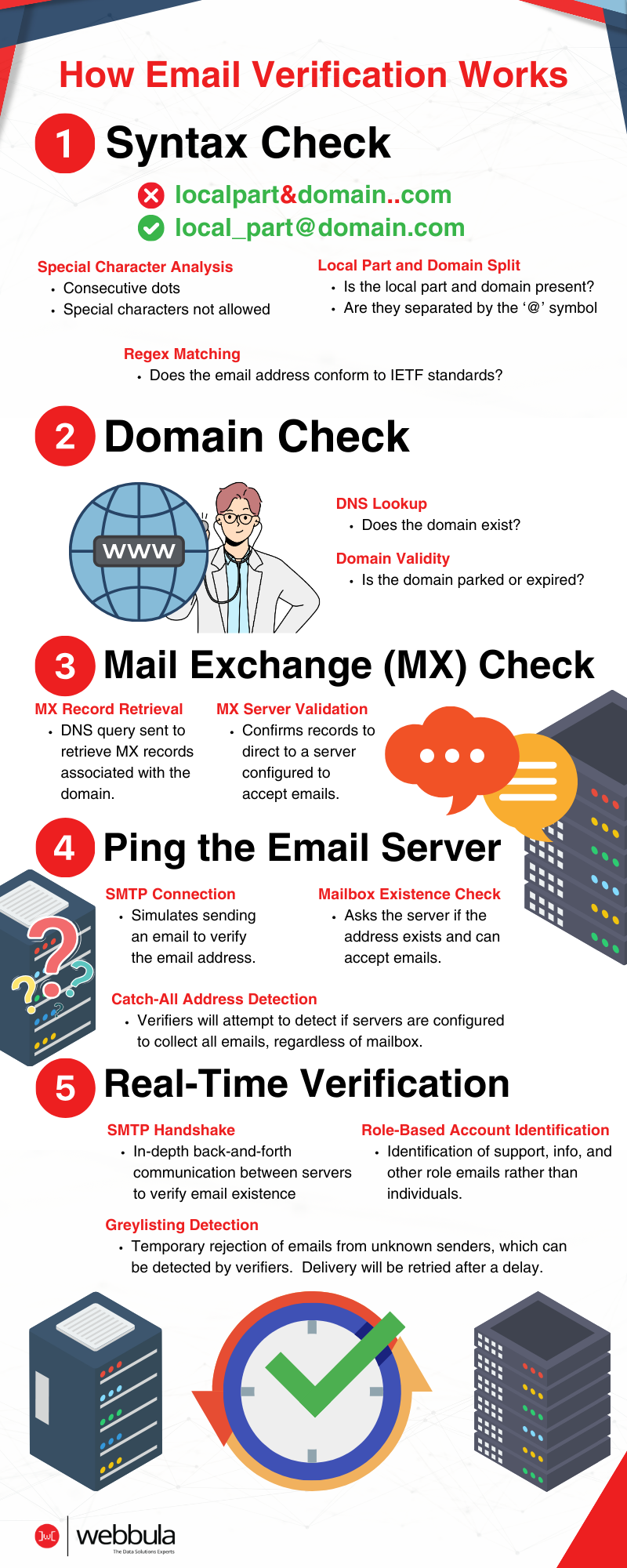
Email verification is a detailed process involving several technical steps. Here’s a closer look at how each step is accomplished:
1. Syntax Check
- Regex Matching: This involves using a regular expression (regex) pattern to check if the email address conforms to the standard format specified by the Internet Engineering Task Force (IETF).
- Special Character Analysis: Ensures that special characters are used correctly (e.g., no consecutive dots, allowed special characters in certain positions).
- Local Part and Domain Split: Verifies that the local part (before the @ symbol) and the domain part (after the @ symbol) are both present and valid.
2. Domain Check
- DNS Lookup: A Domain Name System (DNS) lookup is performed to ensure that the domain exists and is currently active.
- Domain Validity: Checking if the domain is not expired or parked, which could indicate that it’s no longer in use for sending or receiving emails.
3. Mail Exchange (MX) Record Check
- MX Record Retrieval: Queries the DNS to retrieve the MX records associated with the domain, which are necessary for directing email traffic.
- MX Server Validation: Confirms that the retrieved MX records point to a mail server configured to accept emails for the domain in question.
4. Ping the Email Server
- SMTP Connection: Initiates a simple mail transfer protocol (SMTP) session with the mail server to verify the email address. This is done by simulating the sending of an email without actually sending a message.
- Mailbox Existence Check: The verifier uses SMTP commands to ask the mail server if the mailbox exists and can receive emails.
- Catch-All Address Detection: Some servers are configured to catch all emails sent to the domain, regardless of the mailbox. The verifier attempts to detect such configurations to prevent false positives.
5. Real-Time Verification
- SMTP Handshake: This is a more in-depth SMTP check where the verifier goes further than the initial connection, engaging in a back-and-forth with the server to confirm the email address’s existence without sending an actual email.
- Greylisting Detection: Some mail servers use greylisting to prevent spam by temporarily rejecting emails from unknown senders. Verification tools must be able to detect and handle this by retrying after a delay.
- Role-Based Account Identification: Identifies emails associated with roles (e.g., info@, support@) rather than individuals, as these are less likely to engage in email marketing campaigns.
Each step in the process is critical to determine the validity and deliverability of an email address. Sophisticated email verification tools and services use a combination of these methods to provide accurate results while ensuring they do not violate email server protocols or privacy regulations.
The Role of Email Verification in Email Marketing
Email verification isn’t just a housekeeping task; it’s a strategic move that can determine the success of your email marketing campaigns. Below, we outline its indispensable roles:
- Improving Deliverability Email verification ensures your messages reach actual inboxes, not just email servers. This is crucial for email marketing effectiveness.
- Reducing Bounce Rates By verifying emails, you significantly reduce the number of undeliverable emails, known as hard bounces, ensuring your content is reaching an audience that can actually engage with it.
- Protecting Sender Reputation Your sender reputation is at stake with every email sent. Verification safeguards this reputation, ensuring your marketing efforts are not negated by being marked as spam.
- Saving Costs Eliminate costs associated with sending emails to invalid addresses within your existing list. Verification tools can help identify these savings opportunities.
- Increasing Engagement Rates Verified emails lead to more accurate engagement rates, reflecting true user interaction with your lead magnets and content.
- Enhancing Campaign Analytics Clean lists result from thorough list verification, leading to better analytics and insights for your marketing strategies.
- Aiding Compliance with Regulations Email verification aids compliance with regulations, acting as a best practice in maintaining the integrity of your email list.
- Preventing Fraud Address verification is a key component of fraud prevention, ensuring that the contacts you’re engaging with are genuine users.
Conclusion
Email verification is far more than a technical necessity; it is a best practice and a cornerstone of smart email marketing practices. It underpins the validity of your email list, ensuring every email account you contact is active and able to receive emails. It’s about respecting the recipients’ time and inbox, ensuring that every message sent is intentional and targeted.
In the fast-paced realm of digital marketing, verifying emails is akin to ensuring that every address on your list is a sign of a potential customer who has hit ‘enter’ on one of your lead magnets, rather than an invalid entry that could negatively impact your business.
By verifying email addresses, marketers ensure that their marketing efforts are not wasted on invalid or risky emails. It’s an essential practice that goes hand in hand with responsible marketing—protecting your brand, upholding data quality, and ensuring that every email sent is a step towards achieving your campaign’s success.
Commonly Asked Questions
What is the difference between email verification and email validation?
Email verification is the process of ensuring an email address is valid and able to receive messages, whereas email validation simply checks if the email address is formatted correctly according to standards. Verification is a more in-depth process that includes validating the format as well as the existence of the email address.
How often should I verify my email list?
The frequency of email list verification can depend on how often you acquire new contacts and your email bounce rates. A good practice is to verify your email list periodically, such as every quarter, or before any major email marketing campaign to maintain a clean list.
Can email verification prevent all types of email bounces?
Email verification primarily helps prevent hard bounces, which occur when emails are sent to invalid or non-existent addresses. It may not prevent soft bounces, which are typically temporary delivery failures due to issues like a full inbox or server problems.
Is email verification compliant with data protection laws like GDPR?
Yes, email verification can be compliant with GDPR and other data protection laws, as long as the process respects user privacy and data protection standards. It’s important to choose email verification tools that are committed to compliance.
Will using an email verification service impact my sender reputation?
Using an email verification service can actually improve your sender reputation because it helps you maintain a cleaner, more engaged email list. This can lead to higher deliverability rates and fewer spam complaints.