
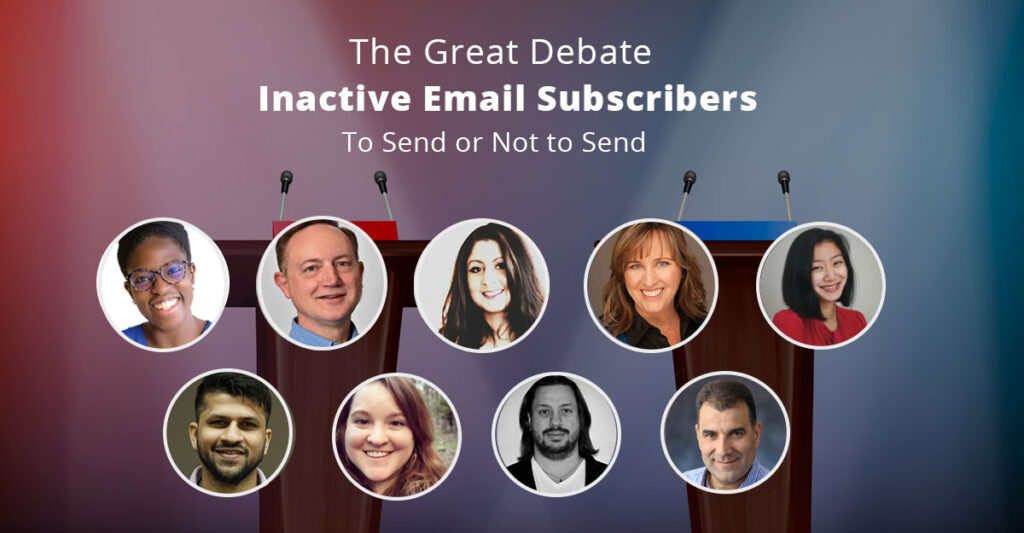


A few weeks ago I came across a very interesting LinkedIn chain, started by Jordie Van Rijn, filled with innovative email experts that references an article by Steve Henderson, “Inactive Contacts in Email Marketing”.
I was intrigued by the amount of opinions people had on this simple topic. Email has been around for a long time and I think what makes this industry so interesting is the ongoing discussion of topics just like these.
What I love about email marketing is that no matter how many days go by, or what side of the debate you are on, email marketing challenges us every day. There are always new things to learn.
I thought it would be fun to gather a few email and deliverability experts to settle this debate and see what their thoughts were on whether to send or not to send to inactive email subscribers.
Here is what they had to say.

Dr. Ada Y. Barlatt
Founder of Operations Ally

To send or not to send — actually, it depends! From my perspective, when it comes to the inactive subscribers on your list, I recommend you focus on carefully defining an inactive subscriber. Incorrectly labeling a subscriber as inactive comes with risks no matter whether you decide to send emails to them or not.
If you aggressively label subscribers inactive and decide “not to send,” you may remove interested people from your list. If you aggressively label subscribers inactive and decide to “send,” you may turn off interested subscribers with frequent re-engagement emails. If you are too relaxed when labeling subscribers inactive, you risk deliverability issues (regardless of your decision to “send” or “not to send”).
So how do you know what criteria to use to identify inactive subscribers on your list? Unfortunately, the criteria to pinpoint an inactive subscriber are different for every organization. To find the best answer for your program, I recommend understanding the distribution of time between key subscriber actions.
If the word “distribution” is scary to you, focus on answering important questions about the duration between key steps in your customer journey — e.g., how long is a subscriber typically on the list before they convert? Or what is the typical duration between purchases for subscribers?
You can use your historical data about the time between key actions (in conjunction with anti-spam laws) to guide your decisions on who to label as inactive, when to send re-engagement campaigns and when to stop sending.

Daniel Deneweth
Head of Email Deliverability Services at Oracle Marketing Consulting
I understand the attraction. Inactive email subscribers represent people who expressed interest in your products or services at some point in the past. They were interested enough to sign up, right? Perhaps they’re just waiting for the right offer, and then they will spring to life. Maybe for the past six months, they’ve been backpacking through Europe, in the hospital, or writing the Great American Novel in a cabin in the woods. But now they’re back home, and ready to shop again.
Wishful thinking is not an effective strategy when it comes to managing inactive subscribers. The decisions you make relative to your contact strategy and inactive email addresses can have a profound impact on the effectiveness of your email marketing programs.
What may start out as just being cautious—making sure you don’t give up on someone too soon—can become a lethal anchor that drags down your email performance. Continuing to hold out hope these people will engage is a form of selective blindness. So far, you’ve probably sent these people dozens, if not hundreds, of email messages and they haven’t responded to any of them. Face facts: they are not interested. Or worse, the email address was originally mistyped. It could now be a spam trap or owned by someone else who does not appreciate receiving your emails. Many people will sign up using a secondary email address and never respond to the emails you send them.
Take a look at the small value actually being derived from this inactive audience segment, and then compare that with a chronic degradation of your email marketing performance from reduced deliverability. You will likely find the benefits don’t come close to outweighing the costs and risks of sending to inactive subscribers. To continue sending to inactive subscribers at the cost of reduced deliverability performance is to fall for fool’s gold.
I’m not saying to never send to less active or even inactive subscribers. A well-considered strategy with selective, occasional touchpoints can be effective. Overall, reducing the amount of emails you send to inactive subscribers will improve your deliverability health. However, anytime you send to inactive subscribers, you need to be very selective. Give up on any wishful thinking these inactive subscribers will suddenly surprise you with interest. Study your performance data, and then let the cost-benefit analysis guide your decision-making.

Komal Helyer
Fractional CMO
Many marketers believe that you should remove your inactive subscribers from your list. After all they could be damaging your deliverability and inbox placement. But I say, just hold on a minute! Ever subscriber is a potential source of revenue. So let’s not give up without a fight!
These subscribers are on your list for a reason. They were engaged with your brand once, there is no reason why you can’t re-engage them again. There’s a great 3 step process you can take to reignite the spark between your brand and the different types of inactive subscribers.
- Identify them. Not all inactives should be treated equally.
- Unengaged – these were once active and engaged but have recently stopped.
- Zombies – These were once very active – but have not engaged in a really long time
- Never actives – They signed up to your newsletter, but have never engaged since
- Segment and personalise
- Unengaged – focus on this segment and get a re-engagement campaign set up. These could be personalised product recommendations, competitions, discounts and reminders.
- Zombies – This segment need to be treated differently. We miss you campaigns, feedback surveys or even a reminder of your preference centre are great ways to re-engage at this stage.
- Never actives – This bunch of subscribers really should be taken out of regular mailings, where frequency is reduced. But before you do a last chance message could be sent to advise their frequency is going to reduce
- Regularly review and automate
An inactive subscriber programme needs to be automated into your marketing automation platform where the above programmes are automated when they slip into the different cohorts.